


From the Black Armada to AUKUS
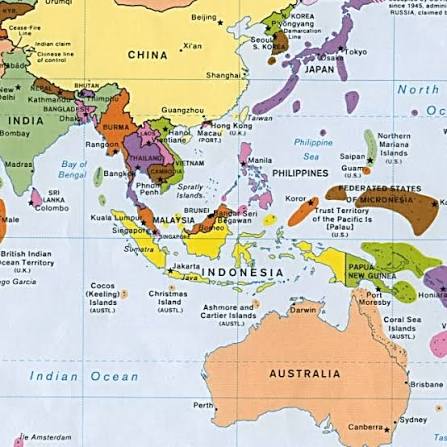
Indonesia–Australia relations are often described as hate but longing. Fundamental differences in principle between the two countries, especially in terms of language and culture, have become one of the roots that make the psychological distance between them difficult to overcome even though geographically they are separated only by a relatively narrow sea. Indonesia and Australia are like a couple who cannot choose their neighbours. Geographical proximity forces them to coexist, but history shows that this relationship has more often been coloured by suspicion than by trust. From the solidarity of Australian workers who boycotted Dutch ships in 1945, to the AUKUS nuclear submarine agreement in 2021, the relations between the two nations seem to revolve in the same cycle. A fragile proximity, easily shaken by perceptions of threat and strategic misunderstanding.
The following piece offers a complete map of the ebb and flow of that relationship. Notably, this review does not stop at the heroic narrative of the Black Armada. The Australian labour movement that refused to transport Dutch troops to Indonesia in 1945–1949. It traces how that solidarity was gradually replaced by the dynamics of strategic suspicion that have persisted for decades, even to this day.
Solidarity Forgotten
The Black Armada is one of the brightest episodes in bilateral relations. When the Netherlands attempted to retake Indonesia after the proclamation of 1945, Australian sailors and workers refused to load Dutch ships. They saw Indonesian independence as an extension of the right to self-determination that they had fought for in their own country. This cross-national solidarity was not merely an anti-colonial sentiment, but a reflection of the class consciousness of Australian workers who felt a shared fate with the people of Indonesia, their nearest neighbour.
In its development, the legacy of the Black Armada became an irony. When Indonesia became independent, Australia, which had initially been supportive, began to see Jakarta as a threat. The West Irian dispute in the 1960s, the Konfrontasi with Malaysia, and Indonesia’s closeness to the Soviet Union and China made Canberra anxious. Australian defence documents from that era show a shift in perception, from anti-colonial friend to a neighbour that must be watched.
Kamaria and the Manufactured Enemy
The most interesting aspect of the following review is its discussion of “Kamaria”, a fictional country used by Australia in the Kangaroo 89 military exercise scenario. Kamaria is depicted as a power from the north threatening Australia. In Canberra’s strategic imagination, “north” almost always means Indonesia. Although not explicitly mentioned, the Kangaroo 89 scenario sent a message that was difficult to misinterpret: that Australia was training to face a threat from Indonesia.
This is the core of the problem in bilateral relations. Australia’s inability to see Indonesia as an equal partner, and Indonesia’s inability to fully trust Australia’s intentions. When East Timor broke away from Indonesia in 1999 and Australia led an international force, that suspicion reached its peak. Bilateral relations fell to their lowest point. The 2006 Lombok Treaty did restore defence cooperation, but old wounds are naturally difficult to erase.
A Repeating Cycle
The pattern visible from these documents is a repeating cycle. Solidarity turns into suspicion, which then continues into crisis. After the recovery stage is successfully achieved, it turns out that yet another suspicion emerges. AUKUS is the latest chapter in that cycle. When Australia decided to purchase nuclear-powered submarines with the assistance of the United States and the United Kingdom, Indonesia, although not directly declaring hostility, nevertheless expressed concern. The question is simple. What does Australia need nuclear-powered submarines for? Canberra’s answer is to anticipate a South China Sea crisis. But in Jakarta, another question arises, a reasonable one. Are those submarines also being prepared to face Indonesia? This is where transparency regarding the need for “prevention of miscalculation” matters. Without honest strategic communication, every arms purchase or military exercise will always be interpreted as a threat. The security dilemma, in which one country strengthens itself, another feels threatened and also strengthens itself. A cycle that will continue to spin.
The Lost Language, Shrinking Knowledge
One of the most touching things is the recent development circulating regarding the Indonesian language in Australia. The number of students studying Indonesian in Australia continues to decline. An Australian parliamentary report states that Australians’ Asia capability is in crisis. This is not merely an educational issue, but a strategic one. Without the ability to speak Indonesian, how can Australia understand Indonesia? Without understanding, how can trust be built? Conversely, in Indonesia, knowledge about Australia is also shallow. The mass media more often report on Australia when there is a crisis in East Timor, Papua, or AUKUS than discuss everyday cooperation. History education in both countries rarely places bilateral relations in a balanced context. As a result, the image of the neighbour is shaped by prejudice and episodic news, rather than by deep understanding.
From Geographical Proximity to Strategic Trust
This review will close with an apt title. “From Geographical Proximity to Strategic Trust.” This title implies that geographical proximity does not automatically give birth to trust. Trust must be built through hard work, among other things through honest dialogue, defence transparency, educational exchange, and sustainable people-to-people relations.
The 2006 Lombok Treaty and various counter-terrorism, maritime security, and disaster relief cooperations are a good foundation. But that foundation is fragile if it is not reinforced by cultural and linguistic understanding. Australia needs to take seriously again the teaching of Indonesian. Indonesia also needs to be more open in studying Australia, not only as a Western country, but as a neighbour with its own political and social dynamics. Most importantly, both countries need to stop creating new “Kamarias”. Military exercise scenarios that implicitly target a neighbour will only reinforce the cycle of suspicion. Conversely, joint exercises, officer exchanges, and informal communication between officers, as have been ongoing, are a more productive way to build trust.
This is where the role of IKAHAN (Indonesia–Australia Defence Alumni Association) and SAG (Senior Advisory Group) actually becomes crucial. Established in 2011, IKAHAN is Indonesia’s first defence alumni association with more than 5,000 members from all ranks and services, which aims to maintain the people-to-people relations that have been built between the TNI and the Australian Defence Force and to provide information on the development of bilateral defence relations. From the outset, IKAHAN and SAG were indeed intended as communication bridges at all levels, from cadets to senior defence leaders.
The Legacy of the Black Armada as a Lesson
The Black Armada teaches that solidarity between the peoples of Indonesia and Australia once existed, and that it was real. But that solidarity was built by workers, sailors, and activists, not by elites in government. Today, when bilateral relations are more determined by political and military elites, the legacy of the Black Armada should serve as a reminder. Strong relations are not built on defence documents, but on a sense of mutual understanding between peoples.
Indonesia and Australia cannot change geography. They will always be neighbours. What can be changed is the way they view one another. From the Black Armada to AUKUS, we learn that suspicion is a choice, and so is trust. It is time for both nations to choose the latter. Both countries must immediately end the pattern of relations that appears as a relationship of Hate but Longing!
Jakarta, 9 October 2026
Chappy Hakim – Indonesian Air Power Study Centre (This piece is a personal opinion)
