


“Our Ancestors Were Seafarers, Our Children Will Be People of the Skies”
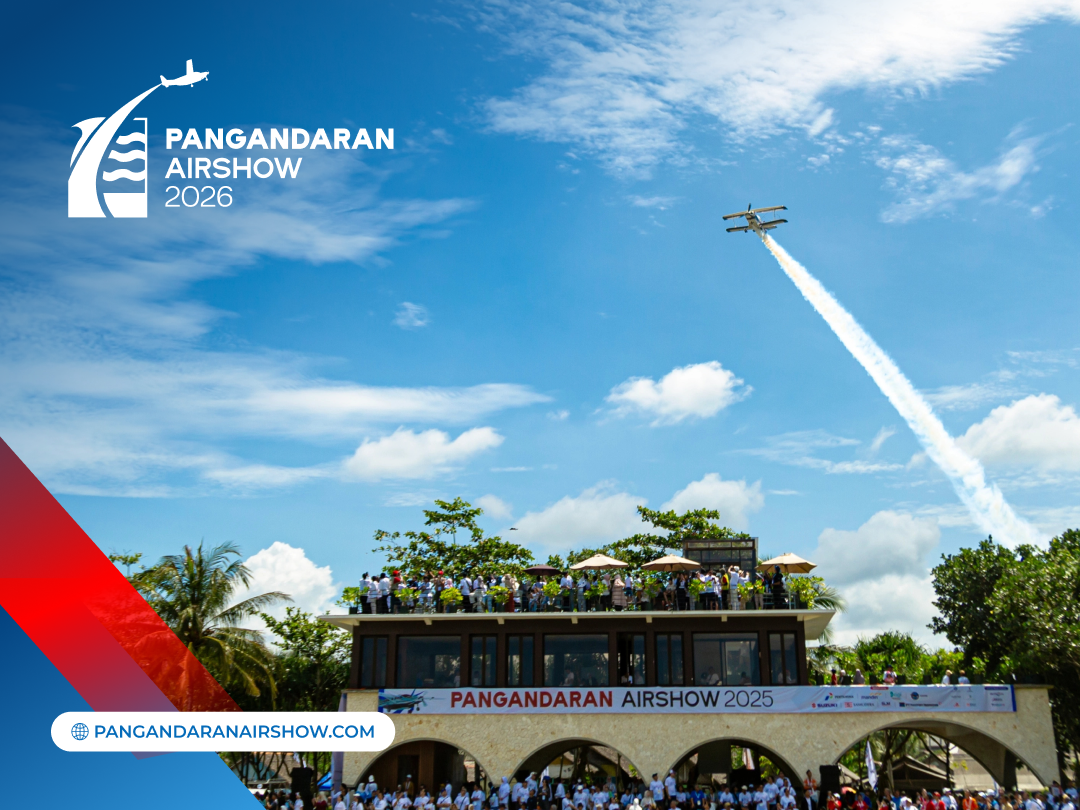
There is always something fascinating about an aircraft flying over the beach. The sound of its engine sparks curiosity, its movement makes people look up, and for a child, seeing an aircraft in the sky may well be the beginning of a dream.
That is why the Pangandaran Airshow 2026, taking place from September 4–6, should not be seen merely as an aviation spectacle. More than that, it can become an important moment to revive and strengthen Indonesia’s aviation culture.
Indonesia has long been known as a maritime nation. The sea is not simply a vast expanse separating thousands of islands; it is a space that has shaped our history, identity, and way of life. We have a familiar expression that captures this identity perfectly “Our ancestors were seafarers.”
But times are changing. If our ancestors crossed the oceans in boats and ships, future generations will live in a world increasingly connected through the air and beyond, into space. Aviation technology is advancing rapidly. Aircraft, drones, satellites, artificial intelligence, navigation systems, and other aerospace technologies are becoming an increasingly important part of modern life.
Perhaps, therefore, it is time to add a new expression: “Our ancestors were seafarers, our children will be people of the skies.” This is more than just a slogan. It reflects the transformation of Indonesia as a nation. We do not have to leave behind our maritime identity. On the contrary, our maritime strength and our air power should develop together. The sea is the lifeblood of Indonesia, while the airspace above it connects, protects, and supports the nation.
Pangandaran has a particularly interesting place in this context. An airshow held along the coast creates a symbolic meeting between two worlds: the sea and the sky. From Pangandaran’s beaches, people can watch aircraft flying above the Indian Ocean. This beautiful scene carries a deeper message: Indonesia possesses an enormous maritime domain, together with the vast airspace above it. Both are inseparable parts of our national interests. That is why an airshow should not end with the excitement of aerobatics, the roar of engines, or the beauty of aircraft. Behind the spectacle lies a much larger aviation ecosystem that deserves to be introduced to the younger generation: pilots, aircraft technicians, engineers, air traffic controllers, meteorologists, airport operators, aviation safety professionals, aircraft manufacturers, drone technology specialists, satellite experts, and many other aerospace professions. Imagine a child coming to Pangandaran simply to watch aircraft. That child may go home with a dream “One day, I want to become a pilot.” Another may say “I want to build aircraft.” Someone else may become interested in becoming a technician, an air traffic controller, a satellite specialist, or an innovator in unmanned aircraft technology. This is where the true strategic value of an airshow lies. It opens the door to a young generation’s imagination of the future. Indonesia needs a generation that does not merely use aviation technology, but is capable of creating, developing, and mastering it. In the global competition of the future, mastery of air and space technology will increasingly influence the strength and standing of nations.
Therefore, the Pangandaran Airshow 2026 should be seen as more than a festival. It is a bridge from Indonesia’s maritime heritage toward its aerospace future. Our ancestors were indeed seafarers. They taught us the courage to cross oceans and explore the world. Now it is our turn to prepare the next generation to reach higher to explore and master the world above us. Our children must become people of the skies. And perhaps one day, when the aircraft of the future fly across the Indonesian archipelago, Indonesian children will no longer look up merely in admiration. They will look up and say: “That is our future.” Our Ancestors Were Seafarers. Our Children Will Be People of the Skies.
That is the spirit we should carry from Pangandaran from the sea, looking toward the sky, and toward the future of Indonesia.
Jakarta, September 4, 2026
Chappy Hakim
Indonesia Center for Air Power Studies
Top of Form
Bottom of Form
